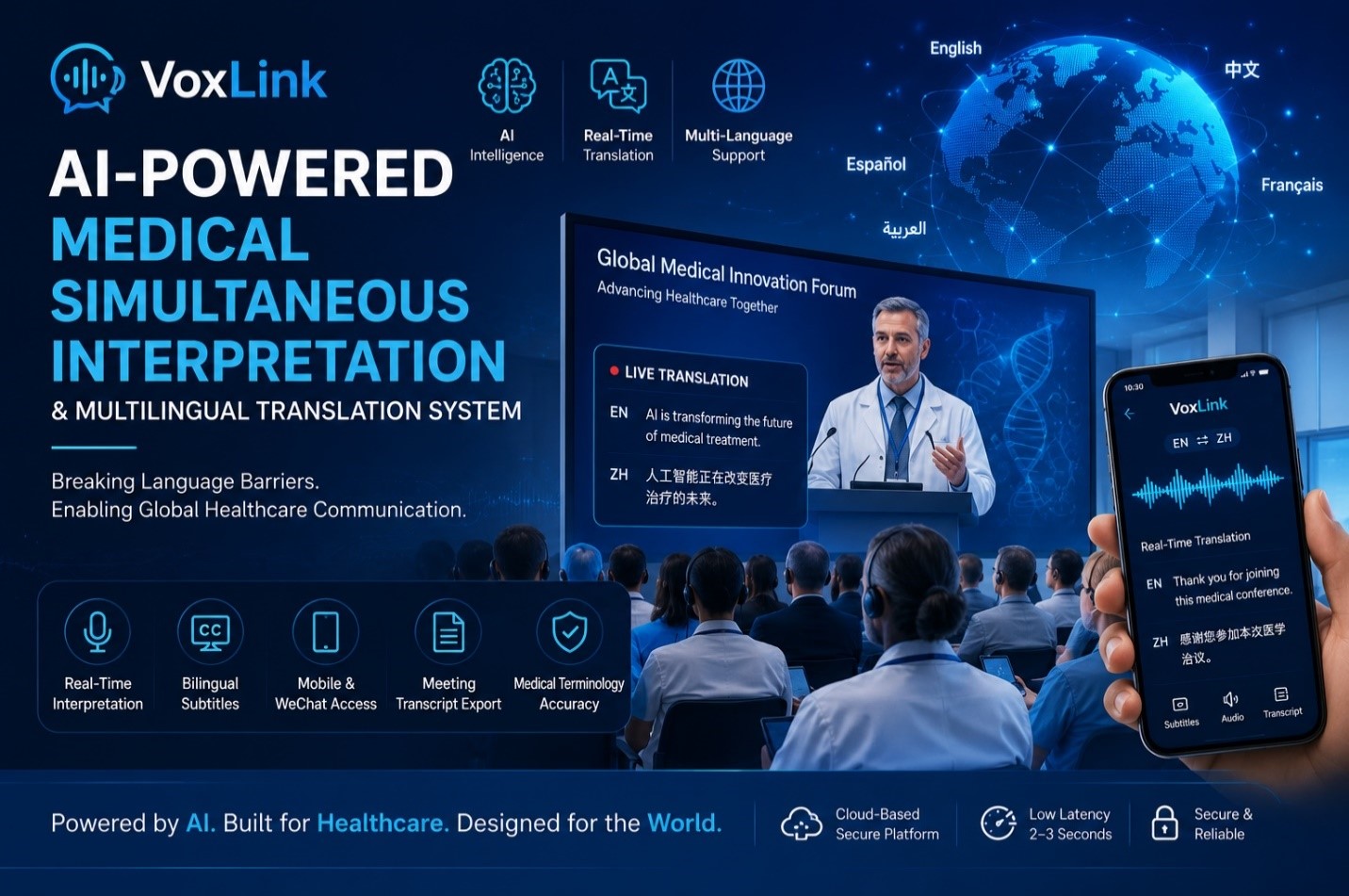
In today’s globalized healthcare and pharmaceutical industries, communication across multiple languages has become essential. International conferences, multinational clinical trials, product launches, medical training sessions, and research collaborations often involve experts from different countries. Language barriers can delay decision-making, increase operational costs, and reduce the quality of communication. To solve these challenges, innovative language technologies are being developed. One such solution is VoxLink, an AI-powered real-time speech interpretation and multilingual translation platform developed by Willingjet Life Science Co., Ltd.
VoxLink is designed specifically for medical and professional conference environments. Unlike ordinary translation apps, it combines speech recognition, machine translation, subtitle generation, cloud computing, and mobile accessibility to provide accurate real-time communication. This assignment examines VoxLink’s features, architecture, applications, competitive advantages, and its future relevance in healthcare and global business (Voxlink Medical Simultaneous Interpretation & Multilingual Translation, n.d.).
The company’s long experience in medical terminology and regulated industries created the foundation for developing VoxLink. Since healthcare communication requires technical accuracy, Kangmaofeng used its vast medical translation database to train VoxLink’s engine.
VoxLink is a real-time speech processing system based on Azure cloud speech services combined with Kangmaofeng’s specialized medical translation capabilities. It integrates several core technologies into one platform:
● Audio acquisition
● Speech recognition
● Machine translation
● Subtitle generation
● Multi-terminal distribution
● WeChat ecosystem access
● Meeting transcript export
Its main purpose is to convert spoken language into translated text or audio in real time for multilingual audiences.
This makes it highly useful in situations where live communication is necessary but human interpreters may be expensive, unavailable, or less scalable (Voxlink Medical Simultaneous Interpretation & Multilingual Translation, n.d.).
The VoxLink platform uses a modern cloud-based system known as “local data collection + cloud processing + centralized distribution.” According to the presentation, it contains five major layers:
Captures speech through microphones, sound cards, or conference audio systems.
The PC client manages local settings such as language selection, audio input configuration, and session control.
Uses Azure speech technology and AI translation engines for converting spoken language into translated output.
Processes the translated content and distributes it to users.
End users can receive outputs on:
● PC screens
● Large event screens
● Mobile devices
● WeChat Mini Program
This architecture allows VoxLink to operate efficiently even in large conferences.
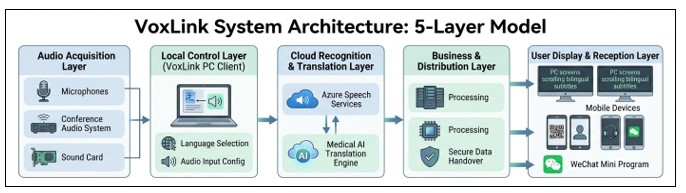
Figure 1. 5-layer model of VoxLink system Architecture
The most important feature of VoxLink is live simultaneous translation. Users can listen or read translations while the speaker is talking.
Bilingual subtitles can scroll in real time on conference screens. This helps participants understand technical presentations clearly.
Users can scan a QR code and listen to translated speech on their smartphones.
After the event, bilingual transcripts can be exported for records, compliance, and follow-up communication.
VoxLink is trained using large-scale medical corpora, which improves recognition of technical terms, abbreviations, and scientific vocabulary.
The platform claims Chinese-English simultaneous interpretation with an average delay of 2–3 seconds, which is highly competitive (Willingjet Showcased Its Innovative Medical Simultaneous Interpretation Engine, Voxlink, at the 2026 CMAC Conference, Sparking Heated Discussions in the Industry about AI-Enabled Cross-Language Communication in Medicine, 2026).
VoxLink can be used in many professional environments:
Doctors, researchers, and specialists from multiple countries can discuss diagnosis, treatment, and clinical innovation.
Global teams can collaborate faster during drug development.
Supports communication between international trial centers.
Useful for introducing new drugs, devices, or biotech products.
Public institutions can use it for multilingual seminars.
Multinational organizations can train employees across regions.
One case describes a high-level international medical forum at a leading hospital. The conference focused on:
● Cardiovascular disease diagnosis and treatment
● AI clinical applications
● Case analysis
● Multidisciplinary expert exchange
Challenges included:
High density of medical terminology
Fast-speaking doctors
Strong professional jargon
Data security requirements
Need for low-latency Chinese-English communication
VoxLink provided:
● Optimized medical speech recognition
● Enhanced terminology recognition
● Low-latency two-way simultaneous interpretation
Conference organizers reported accurate terminology recognition, smooth communication, and reduced costs compared with human simultaneous interpreters.
This case shows that VoxLink is practical in demanding real-world environments.
Unlike general-purpose translators, VoxLink focuses on medical and regulated industries where precision matters.
Traditional simultaneous interpretation requires human interpreters, booths, equipment, and logistics. VoxLink reduces these costs significantly.
Real-time subtitles and instant translation speed up communication and decision-making.
The platform can serve large audiences more easily than hiring multiple interpreters.
The system is powered by Kangmaofeng’s large medical language database.
AI systems can run continuously without scheduling constraints (Zhang & Xie, 2025).
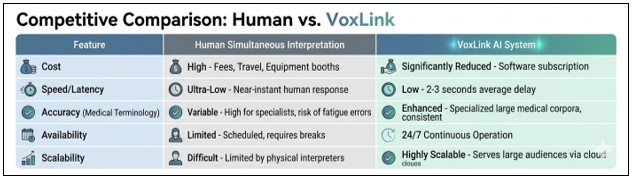
Figure 2. Human vs VoxLink comparison chart
The future of VoxLink appears strong because demand for multilingual communication is increasing. Potential future improvements may include the following (Gany et al., 2007; Li et al., 2025).
● More language pairs beyond Chinese-English
● Better voice cloning and natural speech output
● Offline secure hospital deployment
● Integration with Zoom, Teams, and Webex
● AI summarization of meetings
● Searchable medical knowledge transcripts
● Personalized terminology dictionaries
As AI models improve, VoxLink could become a standard communication tool in hospitals, universities, pharma firms, and international organizations (Willingjet Showcased Its Innovative Medical Simultaneous Interpretation Engine, Voxlink, at the 2026 CMAC Conference, Sparking Heated Discussions in the Industry about AI-Enabled Cross-Language Communication in Medicine, 2026).
VoxLink represents an advanced application of artificial intelligence in professional communication. By combining speech recognition, machine translation, subtitles, and cloud distribution, it solves a major problem in global healthcare and business: language barriers. Its specialized focus on medical terminology gives it a strong advantage over generic translation systems. The platform offers cost savings, fast deployment, and scalable multilingual communication for conferences and research collaborations.
VoxLink demonstrates how AI can transform international communication. In sectors such as medicine, where precision and speed are critical, platforms like VoxLink can significantly improve efficiency and collaboration. As technology continues to evolve, VoxLink may become a leading solution for multilingual medical communication worldwide.
Recent academic studies show that AI-supported simultaneous interpretation systems are becoming increasingly effective in conferences, healthcare, and education. Research indicates that combining subtitles with live translation can improve comprehension and reduce user stress. Mobile interpretation systems also increase access and convenience for participants using smartphones. In medical environments, voice-based AI translation tools help reduce communication barriers between doctors and international participants. These findings strongly support the practical value of VoxLink as a next-generation multilingual communication platform
Gany, F., Kapelusznik, L., Prakash, K., Gonzalez, J., Orta, L. Y., Tseng, C.-H., & Changrani, J. (2007). The impact of medical interpretation method on time and errors. Journal of General Internal Medicine, 22(S2), 319–323. https://doi.org/10.1007/s11606-007-0361-7
Kang Maofeng showcased its innovative medical simultaneous interpretation engine, Voxlink, at the 2026 CMAC conference, sparking heated discussions in the industry about AI-enabled cross-language communication in medicine. (2026, March 23).
Li, Y., Diao, J., & Cheung, A. K. F. (2025). Simultaneous interpreting with auto-subtitling: Investigating viewer cognitive effort, stress, and comprehension. PLOS One, 20(8), e0330692. https://doi.org/10.1371/journal.pone.0330692
Voxlink Medical Simultaneous Interpretation & Multilingual Translation. (n.d.). Retrieved May 2, 2026, from www.chinapharmconsulting.com
Zhang, wenkang, & Xie, R. (2025). Monolingual versus bilingual captioning: An ergonomic perspective on computer-assisted simultaneous interpreting. Vol. 5(2), 131–153.

 EN
EN  cn
cn  de
de  jp
jp